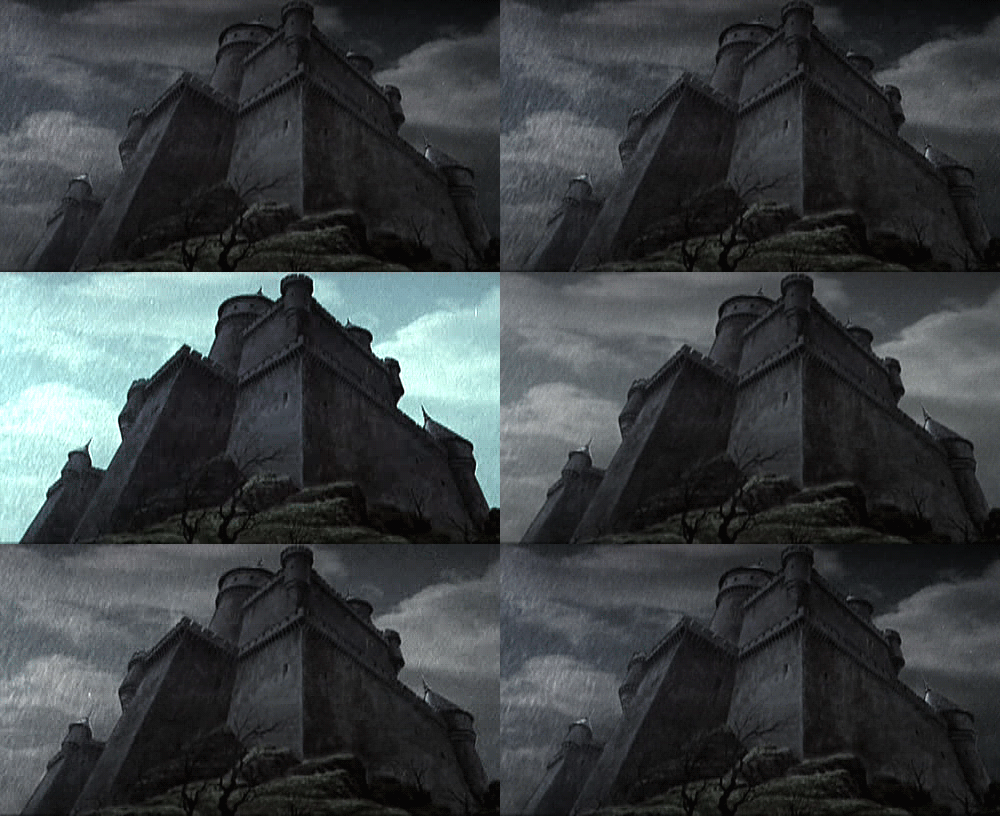
Origin & Development-
The earliest significant usage of the term (as applied to music) was by Joy Division's producer, Tony Wilson on 15 September 1979 in an interview for the BBC TV program's Something Else: Wilson described Joy Division as "gothic" compared to the pop mainstream, right before a live performance of the band. In 1979, the term was later applied to "newer bands such as Bauhaus who had arrived in the wake of Joy Division and Siouxsie and the Banshees". In 1979,Sounds described Joy Division as "gothic" and "theatrical". In February 1980, Melody Maker qualified the same band as "masters of this Gothic gloom". Critic Jon Savage would later say that their singer Ian Curtis wrote "the definitive Northern Gothic statement".
However, it was not until the early 1980s that gothic rock became a coherent music subgenre within post-punk, and that followers of these bands started to come together as a distinctly recognisable movement. They may have taken the "goth" mantle from a 1981 article published in UK rock weekly Sounds: "The face of Punk Gothique", written by Steve Keaton. In a text about the audience of UK Decay, Keaton asked: "Could this be the coming of Punk Gothique? With Bauhaus flying in on similar wings could it be the next big thing?". In July 1982, the opening of the Batcave in London's Soho provided a prominent meeting point for the emerging scene, which would be briefly labelled "positive punk" by the NME in a special issue with a front cover in early 1983. The term "Batcaver" was then used to describe old-school goths.
Independent from the British scene, in the late 1970s and early 1980s in California, deathrock developed as a distinct branch of American punk rock.

Gothic Genre-
By the mid-1980s, bands began proliferating and became increasingly popular, including The Sisters of Mercy, The Mission(known as The Mission UK in the U.S.), The March Violets, Ausgang, Kommunity FK, Xmal Deutschland, Clan Of Xymox, Dead Can Dance, This Mortal Coil, The Bolshoi, and Fields of the Nephilim. Record labels Factory, 4AD andBeggars Banquet released much of this music in Europe, while Cleopatra, among others, released the music in the U.S., where the subculture grew, especially in New York and Los Angeles, California, where many nightclubs featured "gothic/industrial" nights. The popularity of 4AD bands resulted in the creation of a similar U.S. label, Projekt, which produces what was colloquially termed ethereal wave, a subgenre of dark wave music.
The 1990s saw further growth for some '80s bands and the emergence of many new acts. Styles of music heard in goth venues ranged from gothic rock, deathroc], industrial music, EBM, ambient, experimental pop, new wave, synthpop and punk rock.
The 2000s saw a resurgence in the early positive punk and deathrock sound in reaction to aggrotech, industrial , and synthpop, which had taken over many goth clubs. Nights like Ghoul School and Release the Bats promoted deathrock, and events such as the Drop Dead Festival attracted deathrock fans from around the world.
Today, the goth music scene thrives in Western Europe, with large annual festivals in Germany, including Wave-Gotik-Treffen (Leipzig) and M'era Luna (Hildesheim), both annually attracting tens of thousands of attendants.

18th and 19th centuries-
Gothic literature combines dark elements of both horror and romance: English author Horace Walpole, with his 1764 novelThe Castle of Otranto is one of the first writers who explored this genre. The Revolutionary War-era "American Gothic" story of the Headless Horseman, immortalized in Washington Irving's story "The Legend of Sleepy Hollow" (published in 1820), marked the arrival in the New World of dark, romantic storytelling. The tale was composed by Irving while he was living in England, and was based on popular tales told by colonial Dutch settlers of New York's Hudson River valley. The story would be adapted to film in 1922 and 1949 in the animated The Adventures of Ichabod and Mr. Toad. It would be re-adapted in 1980 and again in Tim Burton's 1999 Sleepy Hollow.
Throughout the evolution of goth subculture, classic romantic, Gothic and horror literature has played a significant role. Poe,Lovecraft, E.T.A. Hoffmann, Baudelaire, and other tragic and romantic writers have become as emblematic of the subculture as the use of dark eyeliner or dressing in black.
20th century influences-
By the 1960s, TV series such as The Addams Family and The Munsters used these stereotypes for camp comedy. TheByronic hero, in particular, was a key precursor to the male goth image, while Dracula's iconic portrayal by Bela Lugosiappealed powerfully to early goths. They were attracted by Lugosi's aura of camp menace, elegance and mystique. Some people credit the band Bauhaus' first single "Bela Lugosi's Dead", released in August 1979, with the start of the goth subculture, though many prior arthouse movements influenced gothic fashion and style, the illustrations and paintings of Swiss artist H. R. Giger being one of the earliest. Notable examples of later icons include several bandleaders: Siouxsie Sioux of Siouxsie and the Banshees, Robert Smith of The Cure, and Dave Vanian of The Damned. Some members of Bauhaus were, themselves, fine art students or active artists.
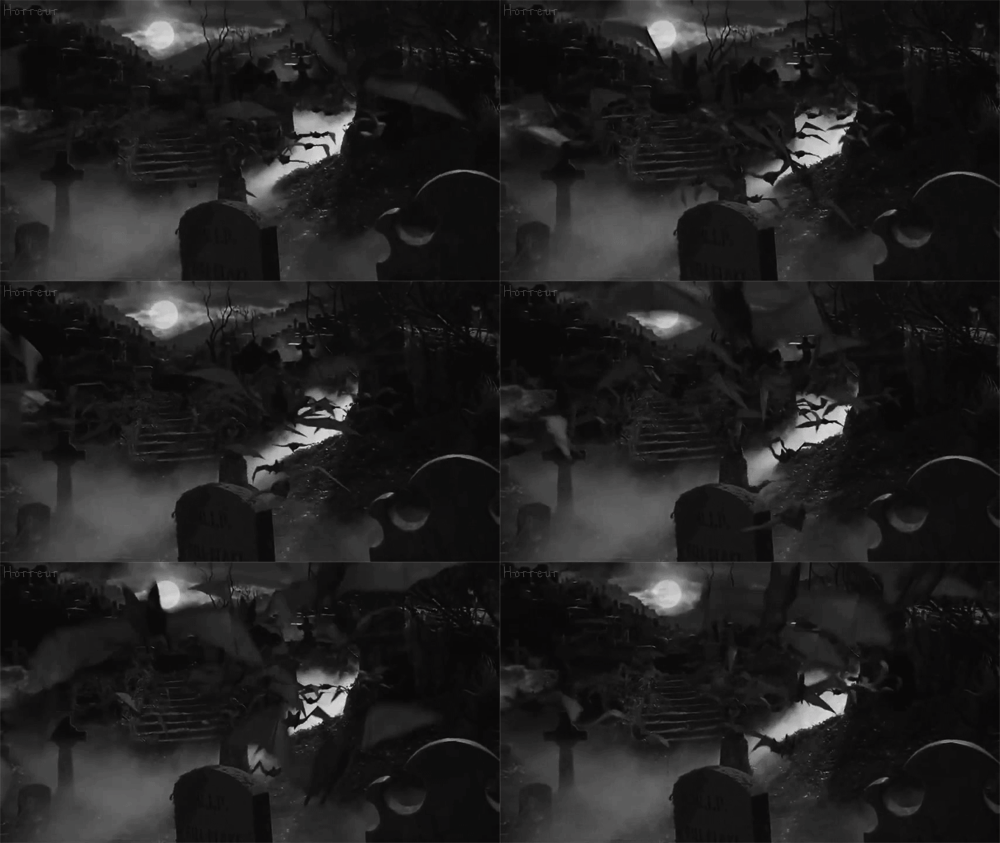
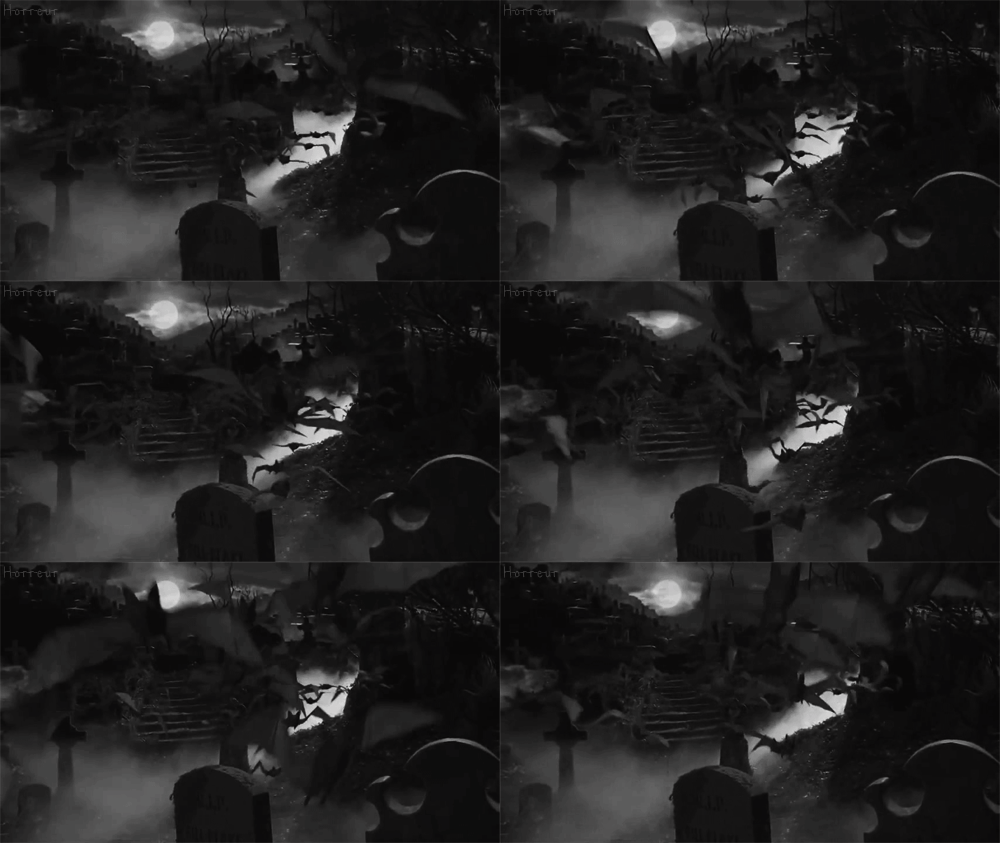
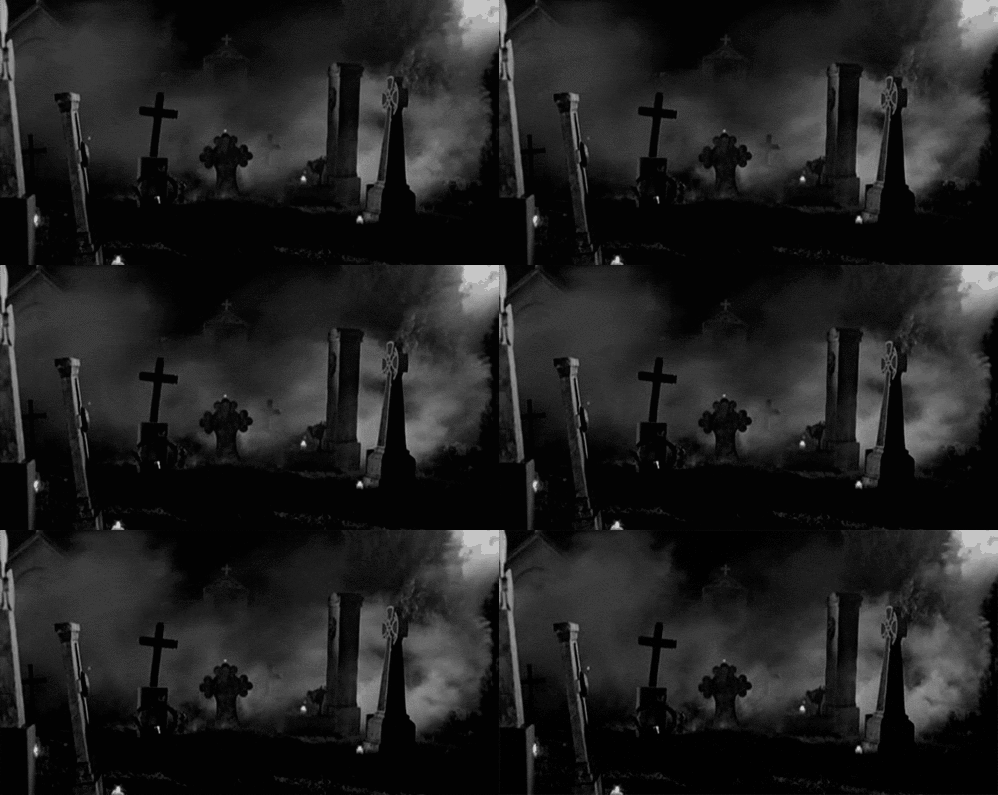
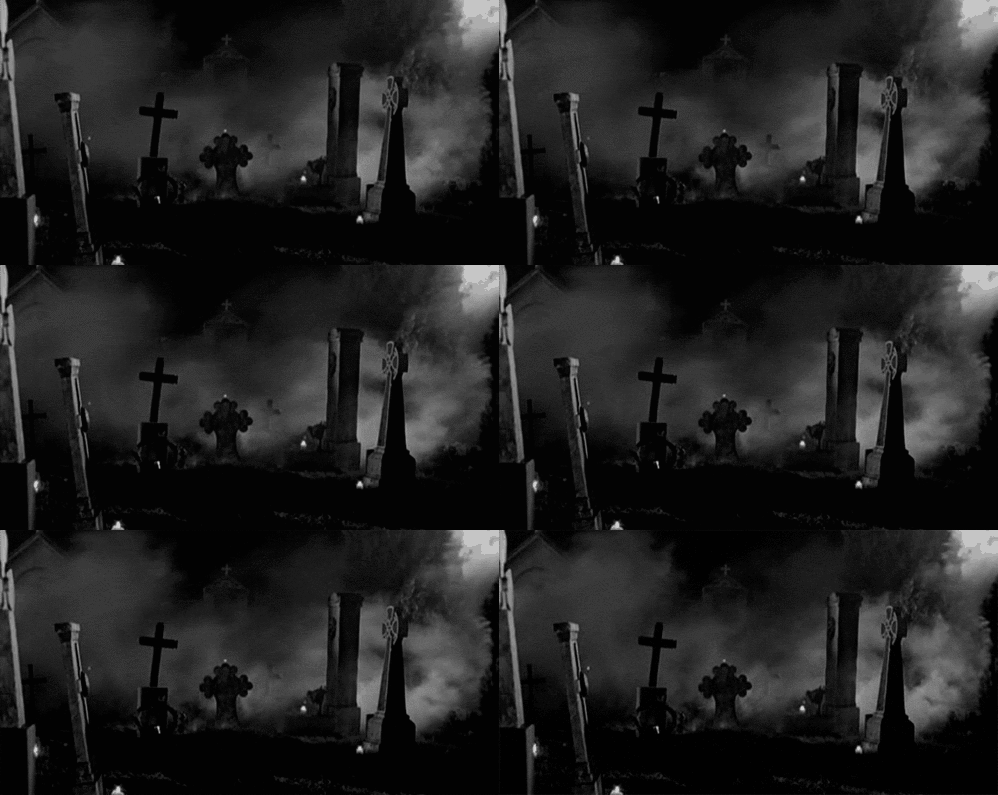
Some of the early gothic rock and deathrock artists adopted traditional horror film images and drew on horror film soundtracks for inspiration. Their audiences responded by adopting appropriate dress and props. Use of standard horror film props like swirling smoke, rubber bats, and cobwebs featured as gothic club décor from the beginning in The Batcave. Such references in bands' music and images were originally tongue-in-cheek, but as time went on, bands and members of the subculture took the connection more seriously. As a result, morbid, supernatural and occult themes became more noticeably serious in the subculture. The interconnection between horror and goth was highlighted in its early days by The Hunger, a 1983 vampire film starring David Bowie, Catherine Deneuve and Susan Sarandon. The film featured gothic rock group Bauhaus performing Bela Lugosi's Dead in a nightclub. Tim Burton created a storybook atmosphere filled with darkness and shadow in some of his films like Edward Scissorhands, Beetlejuice and Batman.

Popular literature-
A literary influence on the gothic scene was Anne Rice's re-imagining of the idea of the vampire. Rice's characters were depicted as struggling with eternity and loneliness. Their ambivalent or tragic sexuality held deep attractions for many goth readers, making her works popular in the 1980s through the 1990s.
The re-imagining of the vampire continued with the release of Poppy Z. Brite's book Lost Souls in October 1992. Despite the fact that Brite's first novel was criticized by some mainstream sources for allegedly "lack[ing] a moral center: neither terrifyingly malevolent supernatural creatures nor (like Anne Rice's protagonists) tortured souls torn between good and evil, these vampires simply add blood-drinking to the amoral panoply of drug abuse, problem drinking by their human counterparts", many of these so-called "human counterparts" identified with the teen angst and Goth music references therein, keeping the book in print. Upon release of a special 10th anniversary edition of Lost Souls,Publishers Weekly—the same periodical that criticized the novel's "amorality" a decade prior—deemed it a "modern horror classic" and acknowledged that Brite established a "cult audience".
As the subculture became well-established, the connection between goth and horror fiction became almost a cliché, with goths quite likely to appear as characters in horror novels and film. For example, The Crow drew directly on goth music and style. Neil Gaiman's acclaimed graphic novel series The Sandman influenced goths with characters like the dark, brooding Dream and his sister Death.
Mick Mercer's 2002 release 21st Century Goth explores the modern state of the goth scene around the world, includingSouth America, Japan, and mainland Asia. His previous 1997 release, Hex Files: The Goth Bible similarly took an international look at the subculture.
Visual art influences-
The gothic subculture has influenced different artists—not only musicians—but also painters and photographers. In particular their work is based on mystic, morbid and romantic motifs. In photography and painting the spectrum varies from erotic artwork to romantic images of vampires or ghosts. To be present is a marked preference for dark colours and sentiments, similar to Gothic fiction, Pre-Raphaelites or Art Nouveau. In the fine art field, Anne Sudworth is a well-known artist with her dark, nocturnal works and strong gothic imagery.
Other contemporary graphic artists with this aesthetic include Gerald Brom, Luis Royo, Dave McKean, Trevor Brown, Victoria Francés as well as the American comic artist James O'Barr. H. R. Giger of Switzerland is one of the first graphic artists to make serious contributions to the gothic/industrial look of much of modern cinema with his work on the 1979 film Alien by Ridley Scott. The artwork of Polish surrealist painter Zdzisław Beksiński is often described as gothic.
Gothic fashion is stereotyped as conspicuously dark, eerie, mysterious, complex and exotic. Typical gothic fashion includes dyed black hair, dark eyeliner, black fingernails and black period-styled clothing; goths may or may not have piercings. Styles are often borrowed from the Elizabethan, Victorian or medieval period and often express pagan, occult or other religious imagery. Gothic fashion may also featuresilver jewelry and studs.
The New York Times noted: "The costumes and ornaments are a glamorous cover for the genre's somber themes. In the world of Goth, nature itself lurks as a malign protagonist, causing flesh to rot, rivers to flood, monuments to crumble and women to turn into slatterns, their hair streaming and lipstick askew".
Present-day fashion designers such as John Paul Gaultier, Alexander McQueen, and John Galliano have also been described as practising "haute goth".
Romanticism-
Romanticism (also the Romantic era or the Romantic period) was an artistic, literary, and intellectual movement that originated in Europe toward the end of the 18th century and in most areas was at its peak in the approximate period from 1800 to 1850. Partly a reaction to the Industrial Revolution, it was also a revolt against the aristocratic social and political norms of the Age of Enlightenment and a reaction against the scientific rationalization of nature. It was embodied most strongly in the visual arts, music, and literature, but had a major impact on historiography, education and the natural sciences. Its effect on politics was considerable and complex; while for much of the peak Romantic period it was associated with liberalism and radicalism, its long-term effect on the growth of nationalism was probably more significant.
The movement validated intense emotion as an authentic source of aesthetic experience, placing new emphasis on such emotions as apprehension, horror and terror, and awe—especially that which is experienced in confronting the sublimity of untamed nature and its picturesque qualities: both new aesthetic categories. It elevated folk art and ancient custom to a noble status, made spontaneity a desirable characteristic (as in the musical impromptu), and argued for a natural epistemology of human activities, as conditioned by nature in the form of language and customary usage. Romanticism reached beyond the rational and Classicist ideal models to raise a revived medievalism and elements of art and narrative perceived to be authentically medieval in an attempt to escape the confines of population growth, urban sprawl, and industrialism. Romanticism embraced the exotic, the unfamiliar, and the distant in modes more authentic than Rococo chinoiserie, harnessing the power of the imagination to envision and to escape.
Although the movement was rooted in the German Sturm und Drangmovement, which prized intuition and emotion over the rationalism of the Enlightenment, the events of and ideologies that led to the French Revolution planted the seeds from which both Romanticism and the Counter-Enlightenment sprouted. The confines of the Industrial Revolution also had their influence on Romanticism, which was in part an escape from modern realities. Indeed, in the second half of the 19th century, "Realism" was offered as a polarized opposite to Romanticism. Romanticism assigned a high value to the achievements of 'heroic' individualists and artists, whose pioneering examples, it maintained, would raise the quality of society. It also vouched for the individual imagination as a critical authority allowed of freedom from classical notions of form in art. There was a strong recourse to historical and natural inevitability, a Zeitgeist, in the representation of its ideas.
.gif?timestamp=1512194761375)
.gif?timestamp=1512194775530)
